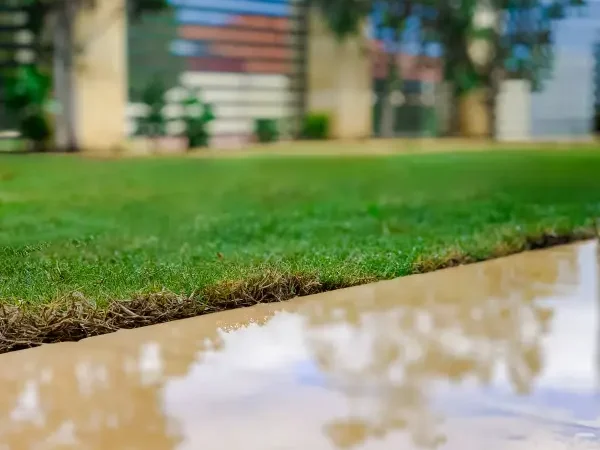
Plenty of Perth homeowners wonder whether synthetic turf would be easier than real grass. It looks neat at first, but the long-term picture is different, especially in WA heat.
Real grass in Perth
- Stays much cooler than synthetic turf or paving in full sun.
- Absorbs carbon dioxide and releases oxygen.
- Filters water, slows runoff and improves the soil.
- Feels cool and safe under bare feet.
It does need mowing, watering and feeding, and it struggles in deep shade or very poor soil. Buffalo, couch and kikuyu all do well in Perth when they're looked after properly.
Where synthetic turf makes sense
Synthetic turf suits spots where real grass can't grow: rooftops and balconies, courtyards with little soil, heavy shade, and purely decorative areas. There it behaves more like paving than a lawn.
The downsides in Perth
- Heat. In full summer sun it gets far hotter than natural grass, hot enough to burn bare feet.
- It doesn't absorb carbon dioxide or produce oxygen.
- It can warm the air around the house.
It still needs maintenance
Leaves and debris need removing, infill gets tracked inside, moss and weeds appear on the surface, and it needs cleaning to stop odours, especially with pets.
Cost over time
Synthetic turf usually costs more up front than a natural lawn, and it needs replacing after roughly 8 to 12 years. In many Perth homes, a well-kept natural lawn costs less over its life.
Which to choose
Choose real grass if the area gets sun, kids or pets use it, and you want a cooler space in summer. Consider synthetic only where grass genuinely won't grow, or the area is decorative.
If your lawn is struggling, the fix is usually in the mowing, watering and feeding rather than the grass. Our lawn care visits are built around Perth's heat and sandy soils.